Tuesday, April 22, 2008

REFLECTIONS ON THE WALL


This is a short audio commentary--my reflections about the wall--as a Jew, an artist, a human being. It was heard on In the Morning with Bonnie Grice on WLIU, 88.3fm www.wliu.org, a public radio station in Southampton, New York on April 9, 2008.

You can hear the commentary on


Wednesday, April 2, 2008

RESISTANCE ART

One of the unintended consequences created by the wall built by Israel to separate Israelis from Palestinians is the canvas it has provided for resistance art by Palestinian as well as international artists.

Unlike the anodyne paintings on the Israeli side of the wall, intended to decorate and beautify rather than to politicize, art on the Palestinian side often dominates the wall with aggressive displays of enormous, bold, vibrant, powerful paintings, often scaled to the 25’ high concrete structure, although others trail off into less dramatic, skillful graffiti.


This is resistance art, art that expresses the anger, militancy and hatred of occupation as well as a yearning for freedom and fantasies of liberation.

Using their imagination to conquer the wall and to fantasize getting to the other side, artists have painted such things as stepladders, stairs, balloons and footsteps. Sections of the wall have been painted to show the wall being breached, to pretend one can see beyond the concrete via windows, curtains, jagged holes to views of the ocean, mountains and fields. I have collected images of paintings, posters and children’s drawings that are not on the wall but also of and about the wall in which the wall is often depicted as a monster or serpent, surrounding and strangling the Palestinian town or village.

I am writing a book about the art and what it signifies about the mind, spirit and psyche of the Palestinians trapped behind the wall. I have also been invited by WLIU, a Long Island-based public radio station, to record a commentary for the daily show about the arts hosted by Bonnie Grice. It can be heard streaming live on wliu.org or on 88.3 fm in the eastern Long Island listening area on Wednesday, April 9 at 8.55 am.

The work is also available as a slide presentation "Facing the Wall" which I will be pleased to present to small groups in the New York area. Please contact me if you are interested.
leafages@optonline.net


Wednesday, March 5, 2008

TWO SIDES OF THE WALL


INTRODUCTION
Designed to separate its people from the Palestinians, Israel began construction in June, 2002 of the wall, also called the fence or separation barrier by Israelis and the ‘apartheid barrier’ by Palestinians, a huge complex of concrete walls, fences, checkpoints, ditches, watchtowers and electronics that runs partially along the Green Line, the border between Israel and the West Bank but also, increasingly, east of that demarcation and on occupied land. The barrier is planned to stretch 400 miles through urban areas and agricultural land. Today it is 57% complete.

Although world opinion, including the International Court of Justice, has condemned the barrier, Israel maintains that it is essential for security, citing the dramatic decrease in suicide bombings and other terrorist attacks following its construction.

The reality of life is very different on each side of the wall: for Israelis, it provides security and peace of mind; for Palestinians, it separates them from not only their land, families, schools and neighborhoods but also interrupts the continuity of their history and geography.

I’ve recorded conversations with people on both sides of the wall: with Yusuf, a 52-year old Palestinian living in Batir, an ancient West Bank village southwest of Jerusalem and west of Bethlehem-- and also with seven Israelis living in Tel-Aviv, Haifa and in and around Jerusalem. Among them are activists, artists, a psychoanalyst, an architect, a storyteller, a professor and a physician.

YUSUF REVISITED
Yusuf’s story is relatively simple: before 1967, Batir was in Jordan. After the Six Day War, it became part of Israel’s occupied territories. Until two years ago, Yusuf was able to move and work between Batir and Israel. Today, Batir is enclosed by the wall and Yusuf has to pass through tunnels and checkpoints to get to work.

A year and a half ago, in June 2006, I interviewed Yusuf, wanting to hear his story and to hear what he and his villagers were sensing about the impending construction of the separation barrier. At that time, he was anxious about the path the wall would take and unsure what the as yet unknown details would mean for his family and the other villagers: he was dreading the feeling of imprisonment and the severing of his life from his land, his work and family and friends in Israel and the West Bank.

One year later, in July of 2007, I met Yusuf again. By then, construction on the wall had begun around Batir and two other West Bank villages, enclosing approximately 18,000 villagers on one-quarter of the land that they had formerly occupied. The only entrance and exit now is through a tunnel and a checkpoint. He drew a map in my notebook to illustrate how the landscape and his life had been altered. It shows the wall around the village and the tunnel as the only exit into the world.


To what extent is the reality of the wall different from what Yusuf had imagined?
In his words:

Now we can see the new wall, where they are building the wall, the implications of how much it will limit us. We feel surrounded, we see the wall, we see how difficult it is, we see the dirt all around us and on us, we're shut in, we can't walk about freely, we can't come and go. How difficult all this is.

This is not just a tunnel, not a regular tunnel. If anyone wants to visit us from somewhere else, they have to go through all sorts of controls and inspections, checkpoints This is the only way to get into Batir. You can’t come and go freely.


Since most of the villages’ agricultural land will now be on the other side of the wall, the villagers will have to go through checkpoints and gates in the wall to tend to their land. The only exit from the villages will be through a tunnel into Palestine. To enter Israel requires police inspection before the tunnel and another checkpoint inspection on the other side, along with a taxi ride. Before the wall was constructed, Yusuf told me, he walked for half an hour, breathing the fresh air, so close that he could see Aminadav, the Israeli village where he has worked for 18 years, from his house.

To arrive at his destination now means getting up two and a half hours earlier, going through inspections and checkpoints, waiting in the queue with hundreds of others, paying fifty shekels or ten dollars for taxi transportation, traveling 25 kilometers and then having to go through the whole thing again in the evening after work. “Two and a half or three hours. It’s a waste of my time”, he says indignantly, “this is no way to live.” He continues:
Everyone has to go to work. To get to Jerusalem, you first have to leave the village, then go through inspection at the tunnel, then enter the Palestinian Authority, then another checkpoint at Rachel's tomb. Every day thousands are waiting in the queue, two hours, soon there will be two checkpoints.

Once the tunnel is completed, the only cars allowed through it and into Palestine, will be Palestinian. They will now be totally separated from Israeli traffic and the two peoples will no longer be able to see each other—except for the Israeli soldiers that Palestinians will see at checkpoints. If they want to enter Israel from, say, Bethlehem, they will have to go through additional checkpoints, similar to passport control.

The three-quarters of their land that now lies outside the wall, land the villagers had never agreed to sell, will become a mandatory sale to be negotiated with Israel. But, Yusuf says, it’s not financial compensation that preoccupies them. Rather, they grapple with how hard it’s going to be to live within the wall and without their land. He shakes his head as he tells me:
“This is their livelihood and their only livelihood. They've always lived from this. They're thinking about how to get their freedom so they can earn a living.”


Yes, you might say, if life is so impossible, let them leave. But where should they go? What kind of work will they do? Other Arab countries are not exactly extending a hand of welcome. And once they leave, they may not be able to return.

Permission to work in Israel is granted only to men over 35 who are married with children but even this permission can be easily and capriciously withdrawn. Life has become not only harsh but unpredictable and precarious.

A year ago, Yusuf could not understand how it had come to this. What has he done to create this situation? What has he done wrong? Why are they all being punished? It is unfathomable.

A year ago, he questioned the rationale of collective punishment and punishment that seemed in no way to fit the crime. “It is hard and bitter for me to leave my birthplace, I’ve built my life here,” he says and I tell him is very hard for me to listen to his story.

Today, his voice rising in anger again, Yusuf is uncomprehending at the injustice that is dismantling his life. In his frustration, he addresses Israel through my recorder:

You can get yourself a stronger army, do something else powerful, I don't know what. You have cameras, you can see everything these days. You don't need to come over here and lock me up in my house. If you're afraid of us, why not build a wall around your house instead of around mine? Why do you take my land away? Before, you had suicide bombers, now you have rockets. What have you gained?

THE ISRAELIS
Every country has a right—and an obligation—to protect its citizens. This is an irrefutable argument that Israel and Israelis make whenever the security barrier is criticized. The deeper criticism—that such security is not justifiable when it imposes collective punishment on people like Yusuf and when it flouts international law—is more difficult to refute.

Those who live and want to remain in Israel are caught in the complexities of these arguments. Liberal and open-minded by nature and conviction, the people I spoke with are confused, tormented even but deeply engaged by the issues. Although they reserve the right to live in safety and in peace in their own country, they also insist they want justice for the Palestinians. Although they are appalled by and often actively protest the brutality of Israel’s occupation, recent images of suicide bombs and the more distant legacy of the Holocaust color and shape their beliefs, perceptions and actions.

The enormity of the security barrier’s presence goes far beyond its physical size—it is also a powerful socio-psychological force. As such, it both attracts and repels, creating legends, myths, contradictions and ambivalences—some of which might be reduced if the wall was built entirely on the 1967 Green Line rather than on occupied Palestinian land.

Some of the Israelis I spoke described the terror that the suicide bombings brought into their lives, the up close and personal nature of the attacks and their unpredictability: living in Israeli cities before the construction of the wall meant you could never be sure you would come home that night. A bomb could get you anywhere any time. In this context, they supported the wall or security barrier, however reluctantly, as, on balance, a necessary solution to the problem.
The proof lies in the pudding, the end justifies the means and Israelis point with restrained and reluctant triumph to the fact that terrorist attacks and suicide bombs have dwindled to virtually nothing. In other words, the wall works. But it also leads to soul-searching, discussion, divisions within families—the far-reaching consequences of what Israelis call ‘the situation’.


The Holocaust
Inevitably, Israelis point to the Holocaust—which in Hebrew is called the Shoah- to explain and justify their fear. If it can happen once it can happen again, they insist. They do not see the parallels with what Palestinians call the Nakba or catastrophe that befell the Palestinian people in 1948 with the establishment of the state of Israel.

More than 500 Palestinian villages were destroyed during and after the 1948 war, resulting in 750,000 Palestinians becoming refugees. The land of these destroyed villages (along with other Palestinian land) was confiscated by the new state of Israel and Jewish settlements, parks and nature reserves were built on top of the ruins. An Israeli organization, Zochrot, the name means “remembering”, is making this history available in Hebrew so that Jews can engage with Palestinians in what Zochrot calls “an open recounting of our painful common history.”


Since most Israelis pay little attention to the Nakba and to Palestinian history it’s not surprising that the larger context for reacting to suicide bombers includes not only personal and national experience with suicide attacks but also expands to the Jewish narrative of the Holocaust and to the uprooting of Jews in Arab countries. Overlaid on this, is a visceral reaction to the very concept of a suicide bomber, an act that Israelis find particularly abhorrent and incomprehensible, as something that stands in profound opposition to the central values of Judaism.

In this context of deep-seated fear in which Palestinians are seen as not only dangerous but as alien and ‘other’, these Israelis grapple with alternative solutions-- weighing the plausibility and possibility and risk of coexistence, of dialogue, of ending the occupation, of remaining within the Green Line, rather than annexing Palestinian territory, of the quandaries inherent in removing Israeli settlements such as Maale Adumim or French Hill.

Many more questions than answers but In the meantime, Yusuf and his family and the villagers of Batir remain behind the wall, with the occupation deepening and thickening its antagonistic infrastructure around them.

A year and a half ago, as we ended our first conversation, Yusuf had very graciously invited me to visit his home in Batir, telling me I would always be most welcome. This time there was no invitation. How do you in good conscience invite a guest who has to traverse checkpoints and inspections to come to your home?

An expanded version of this essay, with interviews, was broadcast on WPKN, an independent radio station in the Connecticut area, on February 28, 29008. It can be heard at:
http://homepage.mac.com/hzelkahan/filechute/Tidings4-Feb28-b.mp3

Wednesday, February 6, 2008

MOVING SETS YOU IN MOTION

I’m thinking of moving

I’ve set myself in motion.


It’s a very big move. It’s the doing of it that’s big, not so much the getting there or being there. It’s pulling up eleven years of roots and hoping not to kill the tree. It’s pruning, shedding, clipping, grafting, transplanting—and taking root again in another soil.

From in here to out there, from crowds to solitude, from concrete to mud, from skyscrapers to woods. I’m moving from one life to another, leaving behind a stressed professional and becoming a person without portfolio or known source of income. I’m going away from neighbors, family and friends to a place where I know one or two people. For all I know, I may be moving from one planet to another. A move, it feels to me, of great consequence. More so because I have not spent much time in planning it, thinking it through, predicting, calculating, being thorough. I am making this move the way I have made many moves in my life—without great consideration and with relatively little thought to the consequences since I had always believed consequences were, for the most part, unknowable. This impulsiveness has led me to live a sprawling, rather untidy life.


The reality of the move rises to meet me and I am consciously gathering my strengths to meet the task. A solitary task it must be and an intensely personal one, like dying or giving birth. Helping hands abound but in the end I realize I do it alone. Of course family and friends will sit with me, will offer advice and help me pack. Movers will lift boxes, the post office will provide change of address forms and the telephone company will convert my area code to one to more accurately reflects my new coordinates. But in the end it becomes a very personal migration, it is me who is taking my body from one life and moving it to another that has not yet been created. I take courage from believing that although the shape of this other life is unknown, it has in a sense always been there, waiting for me to step into it at the right time. Perhaps the drama with which this is playing out comes from the feeling that I am moving into the third—and last—stage of my life. From child to adult to crone. From growing to producing to dying. From gathering to spending to divesting.


Birds and herds and nomads do it
Or, perhaps I simply like the way drama allows me to make more of what some might say is an inevitable, mundane aspect of our hard-wiring. Birds do it, herds do it, even nomads and their yaks do it, we all do it, we move—driven by the seasons, the availability of water or pasture, the ebb and flow of real estate prices, the lure of a new love or job or the lacuna carved by a sudden loss. It’s well known that stress accompanies what sociologists rather flatly refer to as “a mobility event” and what 20% of America, 43 million people do every year, half of them between Memorial Day and Labor Day. What’s the big deal? Moving is something that, on average, Americans do eleven times during their lifetimes. But frequency can’t trivialize the experience nor can the commonplace rob moving of its solemn thumbprint on an individual’s life: people say it takes them at least six months before their new surroundings feel familiar and two years to feel properly settled.

Every time I see a real estate sign planted on a lawn that announces a house is for sale or that it has been sold, I imagine the moving ripples as they spread through a life, a family, a community. Statistics that document this movement are available from numerous sources—local and federal government, the realtor and movers associations, the retail trade where moving creates energetic and lucrative movement of its own from warehouses into consumers’ new homes—40% of people change their brand of toothpaste when they move, opening new doors not only to their new homes perhaps but to a range of new options.
These macro-level moving patterns, interesting and well documented though they are, reveal very little about the real story, about all that actually happens in the internal life of the mover. Certainly I had no idea what I would experience once I had decided to sell my loft in Manhattan and move to a house in the woods, eighty miles east and a thousand lifetimes away.


Living in limbo
All I did know was that my true address belonged neither to the place I currently owned nor to the place I hoped to own but rather that I was living in limbo, where anxiety grew like mold between my twin roles of buyer and seller.

I was still waiting for final mortgage approval for the house I was hoping would become my home. And I was hoping that the final contract signed by the unknown, unseen buyer who had decided my loft would become his home would arrive not too early, not too late but at just the perfect time to coincide with the approval from my bank. I hoped the gods of impeccable sequencing would roll the dice in my direction.

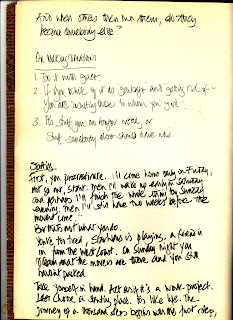
Writing my anxieties would, I thought, contain and dilute them and in my search for an empty notebook I found an old cahier with 48 recycled pages, European-sized and yellowing. On its brown cover inexplicably covered with Australian aborigine beasts and designs, a small crudely drawn alarm clock logo declared le reveil qui sonne. This seemed an appropriate enough wake-up call to which I responded on the first page that: I want to document the move I’m making, to record my ways of doing it, the choices I face and how I resolve them. This will be my meditation, a closing so there can be a new opening which cannot be until I’ve closed the old exit.


I’ve been waiting for the legalities, the final sentence from the bank that is lending me $204,000. They have to type one more clause before the approval is signed and diligently sealed. I’ve been waiting with great anxiety: approval is not an easy thing for a person to wait for. It’s very all or nothing: ‘Yes’, you live. ‘No’, you die. (I guess that’s why they call it ‘the final sentence’!) The lending institutions in this December of 1998 are filled to capacity with demand—I imagine the loan applications piled up, jamming the doors and windows, desks buckling under their weigh, clerical workers, contemptuous of deadlines, arriving late for work and leaving early, so onerous has the paper onslaught become.


I wait and wait for telephone calls that don’t come, harassing my patient mortgage broker who has now transferred my file to his wife, a better candidate for absorbing my daily dose of neurosis which I cannily disguise as pleas for clarification, request for best- and worst-case scenarios, despair over deadlines
missed that now require expensive legal intervention. I imagine the man from whom I’m buying my house in his restless suspicion plotting to tear up our contract and start again, with a buyer who is less lethargic, whose wheels move more smoothly. I am, at this stage, quite unable to turn the tables on myself, the tables I have personally created.. For am I not just a buyer but a seller too?

I think of Polonius and promise myself that in the future I shall neither a borrower nor a lender be, neither a buyer nor a seller ever again. A gypsy maybe, moving with my caravanserai, bonded forever with my tribe, wandering from well to oasis, my camels forever free of lending institutions lawyers and real estate brokers. But for now I am both buyer and seller, eternally captive, forever it seems, in limbo. Yet this same limbo affords me shelter, the refuge of not having to anything just yet, not having to search for the beginning of that ball of yarn that will start the grand unraveling.

But philosophy can sustain and defer only so much. Moving is about action and this is becoming too abstract. In the end, I need strategies, tactics, criteria, decisions and not lofty thinking. I have stuff to move and stuff to remove. How am I going to begin? What’s going to be the first step? Where’s the plan?

I listed these organizing principles, some of which made more sense then than they do now:

1. Discard the chaff which is different from:
2. Select the wheat
3. Keep it all, but categorize: keep forever; keep to sell-after I move (coward!); keep to eventually replace (coward, again!)
4. Give away now: to charity; to family
5. Sell as valuables—Christie’s; sell as accumulation—find that person
6. Garbage


It’s real
Then, in the midst of this self-indulgent strategizing, mirabile dictu! I have a buyer who is willing to pay almost the price I have advertised. (Unlike the stories that proliferated in those heady days, I am not the sort of person who would encounter a buyer willing to pay more than the price I asked. Nor do I win lotteries or receive letters from lawyers that I have been named a beneficiary in the will of a secret admirer.)

This is the seventh offer I have received. I learn the hard way for I tend to believe what people tell me (a natural “mark”, an erstwhile lover once described me). When the first offer was presented to me by J.O., my young and tenacious real estate broker, I felt panic but I was also indignant. How dare they move into my apartment, my terrified inner voice asked. I don’t want anyone else living there. It’s mine. Tell them to go away, I wanted to tell her as silence piled up on the phone lines. Four months and six offers later, I am astute and hardened. My apartment is no longer my home. It has become ‘the property’. Four months later, we count: seventy people have passed through these rooms, leaving their imprints and strangers’ energies in the walls. My home has lost its insularity, it has passed into the realm of public space. Hands in pockets, fingers pointing to this or that feature, this or that problem area, the streams of prospective buyers pinch and poke my nooks and crannies as if they’re selecting the choicest, least bruised apples from a street vendor’s cart. They leave behind the detritus of their valuations and assessments: $50,000 to renovate, $200,000 to gut, needs a new kitchen, floorboards need replacing. They pinch and squeeze the neighborhood, the neighbors, the co-op building’s financial statements. Outside, looking in, they try to imagine what it would be like to be inside, looking out. Most can’t leap over that barrier. They can’t see themselves living where I live. And I can’t see them living here either. I want to tell them they don’t belong here, never will, and what makes them think I would even sell to them?

In the beginning when the loft was first listed on the market, I mercilessly prevailed on J.O. to debrief me after each prospective buyer’s tour of ‘the property’. What did they say? What did they like? Why didn’t they like it? I speculate, as the increasingly silent, long-suffering J.O. listens, whether or not that couple will return, what kind of place such people like. I suggest why they’re not good enough to live here. All this speculation and not once have I ever met one of these people. J.O. tells me when she has set appointments and I leave the apartment to fit in with her schedule. Brokers prefer it when the owner is absent: too much interference, one more unnecessary and distracting variable to deal with. Besides, the owner is not part of the sale and could be a contaminant, blocking the crucial ability of the prospective buyer to project herself into the space, to see herself living there. I’m beginning to understand I am such a contaminant.
After a while, I realize I am becoming a mature seller. I am tired of the involvement with the prospective buyer, bored with routine and undernourished by the debriefs. Buyers as a socio-psychological group no longer interest me and I start to objectify the process. Now all I want is a contract. I don’t care who the person is, what they look like, how their divorce is going, who they vote for or whether they have good taste. Now it is their financials that interest me. And their sincerity. A series of disappointments has taught me that making an offer is not a serious step for many of these shoppers. Sometimes, they even forget they’ve made one. “Tell her $500,000”, they say and are never heard from again. I, on the other hand, felt I was committing to a marriage when I made my offer to the seller of the house I wanted to buy. It did not occur to me that such an offer could be frivolous and retractable. Do, undo. Easy come, easy go. Words lightly spoken and all that… But then I’m a Capricorn. Nest time round, a Gemini maybe?

Horribile dictu! J.O.’s messenger brings me five signed copies of the contracts from a prospective buyer turned real. Nor further denial is possible. Procrastination has lost its spine. The Transition stares me in the face. I remember being at the pinnacle of labor pains with my first child and wishing that I could stop right then and there, turn back, forget the whole thing. I want to stop the sale. But I can’t turn back. New flesh is pressing on the door and I am huddled at the exit, beleaguered, illegitimate, refugee. No help is forthcoming. What shall I do?

First, you procrastinate. I’ll come home early on Friday, I promise myself, not go out. I’ll start on Friday. I didn’t.

I’ll wake up early on Saturday and perhaps I’ll finish the whole thing by Sunday evening. Then I’ll still have two weeks before the movers come.

But I didn’t. Star Wars is playing, a friend is in from the West Coast. On Sunday night I dream that the movers have come and I still haven’t started packing.

I take myself in hand. I am stern. Think of this as a work project, I tell myself. Choose a starting place. It’s like life. The journey of a thousand steps begins with the first step I promise myself that once I start, I’ll get into it. It’ll be like eating peanuts. I won’t want to stop. After all, that is the kind of person I am—compulsive, driven, disciplined.

Start with Closet Number One, that’s what. The northwest corner of my loft. Start there and continue west and south until I come full circle to the front door. I am soothed by the imperative of this geographical decision.

I’m actually beginning to move
Christmas Eve (it’s not my holiday) and I actually do begin.

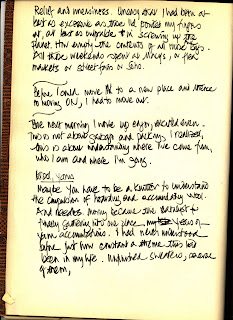
Closet Number One is the worst of all the closets—powerful coats occupy half of it with all the unyielding arrogance of incumbents. They are jostled by wheelies (three pairs-is it possible?) who nudge brutishly at old paints and long-expired Yellow Pages. One small Yellow Pages books is designed for the South Asian community and for those who want to buy what its merchants sell. I am sure, as I discard this now obsolete volume, that those merchants have already followed in the footsteps of their hardworking countrymen into more affluent pastures and now own not just the local kabab stand but a chain of all-night restaurants, a fleet of taxis, a string of newsstands. It is no longer Mohd. Khan, green card immigrant but Mohd. Khan Inc. That’s how long that phone book had settled at the back of this closet. I remind myself to think about my reluctance to throw out old phone books and stand up to tie up the first full black garbage bag, mumbling as the wounded umbrella spoke poking through its side and into my leg.

At midnight, the cupboard is bare except for three piles that I am taking (wheat separated from chaff) and one pile to stay for the new owners: apartment ownership papers, manuals for the appliances, three faded New York Times articles about the landmark building and its history. A fourth pile is for V., the super who is also moving and whose eyes light up when he sees a jam jar of assorted screws, two sheets of lightly-used sandpaper, a paint can with pale yellow rivulets down its side and a can of wood stain.

Next comes Closet Number Two, its doors three feet west of the now tamed Closet Number One. Ah, Two, a snarled testament to celebrations past. Wrapping paper and ribbons shed by years of birthday presents cohabit in exuberant disorder with new rolls of Christwas paper, empty blue boxes from Tiffany, glossy lipstick red ones from Charles Jourdan and endless rolls of ribbon from Lillian Vernon, some of them with curling ends, many of them pristine, waiting to be chosen and matched with presents not yet bought for birthdays not yet celebrated. Dozens of family celebrations replay at the back of my eyes as I remember my children, and then my grandson, impatiently humoring me as I carefully unwrapped each gift,m sliding my finger under the scotch tape not to damage the paper, and also delaying the moment of seeing what wondrous gift it concealed. They rolled their eyes as I folded the paper along its folds and wound the ribbon around my fingers, saving it all for some unknown next time. Years of this along with years of intermittent stops at Hallmark or Kate’s Paperie to find the right paper for this one or that, for Spring or Chanukah or whatever. All these decisions and shops and tissue papers later, I stand overwhelmed at the accumulation, stuffed onto the rows of shelves designed to hold large sheets of professional paper and board by the small advertising agency housed in my loft before me.

Looking at the shelves I realize how much I accommodated myself to the layout and idiosyncracies left by my predecessors. Unlike the slash and burn sentiments expressed by many of the prospective buyers, it didn’t occur to me to do “serious renovation” and ”major gutting”. Since I don’t believe perfection is either attainable or necessary, I am prepared to live with what I deem to be good enough. As a shopper, I don’t wear out my shoe leather in pursuit of the perfect sweater or tea kettle. As a woman, I have never held in my mind the idea of the perfect man and as an artist I have been too zealous in improving a piece—and damaged it irreversibly. Even if perfection does exist and is attainable, I change and with it shifts the absolute beauty of the sweater or the kettle or the man. Good enough is good enough. But it does have to be good. Not just enough.

I think of the country music song that counsels: If you can’t be with the girl you love, love the girl you’re with. Buddha would probably agree.

By midnight, I have filled six garbage bags. I drag them to the garbage room on my floor, grateful that Christmas has taken my neighbors away to their celebrations. I am chagrined by offal just as I am lightened by its removal and relocation. I silently shake my head as I walk back and sit for a moment on the stepladder from which I have been commanding my dismantling campaign and realize this move is a lot bigger and deeper than I anticipated.

Lying in bed that night, relief exchanged place with uneasiness. I wonder how all that accumulation happened. How did I keep stuffing more stuff into those narrow shelves? Where was my consciousness? Did I know deep down that one day I’d be called to account, allowing me to defer and delay until that moment?

I could not deny the evidence: I had been at least as excessive in my consumerism as those at whom I’d virtuously pointed my fingers; I’d been no less culpable than they were in infecting the planet. How empty the contents of those six black bags are! How useless all those weekends spent at flea markets or Soho street fairs or Macy’s.

Before I can move to a new place and truly move ON, I first have to move OUT.

The next morning, Christmas Day for the rest of New York, I wake up eager, excited even. This is not about garbage and packing, I realize. This is about understanding where I’ve come from and where I’m going.

I am possessed
January 1 I have made my way across the west, where most of the closets are located, and am ready to head south.

This move has become a meditation on the meaning of ownership. What is to be with my possessions, to have them? What would it be to be without them, to have the spaces between them rather than the things themselves? Would I feel emptiness, or air?

I’m at the bookshelves no and remove the twelve volumes of Sigmund Freud’s Gesammelte Werke (1924). I’ll never read them so what does removing them mean? My father’s professional preferences and training? My antiquarian bookseller brother’s desire—and resentment? Bibliofind or Bibliolose or Bibliodetach?

The antique rosewood desk that Paul bought at the Armory a dozen years ago and the leather-covered gentleman’s traveling case, replete with crystal containers and ivory-backed hairbrushes? And the life-size bronze horse from India? All impulses belonging to Paul but he’s dead and they’ve lain leaden in my life ever since. I’m moving on and they cannot come along.

I have become the custodian of others’ collections, dragging them with me, searching for bigger quarters so I can house them. Can my new house be truly my own place if these objects, objectively valuable though they may be, have to share it with me? If I own them, who am I? And if others don’t own them, who are they? And when these others own them do they then become somebody else?


Moving sets you in motion, based on these notes, was broadcast on WPKN on January 24, 2008. You can hear it at:
http://eastendreport.files.wordpress.com/2008/01/tidings3-moving-jan24-a.mp3

and for other "Tidings by Hazel
Kahan" http://eastendrep.blogspot.com/2007/12/wpknwpkm-programs-for-download.html

Tuesday, December 11, 2007

SO YOU THINK YOU’RE NOT CREATIVE?

Just because you think you're not creative
doesn't mean you aren't!

Water is H20, hydrogen two parts, oxygen one,
But there is also a third thing that makes it water
And nobody knows what that is.

D. H. Lawrence, The Third Thing

Creativity is a word that is full of light, it glows and it pleases—people like creativity, they admire it, they want it. How can anyone be against such a splendid word? But I am, I have my own little issue with creativity, it makes me nervous. I have seen that it discourages people who think they are not creative. It limits people who think maybe they are a little creative but not very and certainly not as creative as a friend or a co-worker or the artist next door. And I hope to show as I talk with you today we don’t have to be discouraged and we don’t have to set limits. If you don’t already believe you are creative, I hope you will leave today believing with me that creativity is not beyond your reach, that you are not born without it and that you don’t have to think about it as something that happens to other people.

What is creativity anyway, what are we talking about here? To create means to make something where before there was nothing (although I am not sure what that “nothing” would be), to make something that wasn’t there before. To create means to bring into being, to let something become. To make something new of something old. To connect two things that were separate, to make wholes that are greater than the sum of their parts, like D.H. Lawrence’s water. To create means bringing something from darkness into the light.

Where does creativity come from? Is it inside us, waiting to be stirred up or do we actually create whatever it is at that moment? Or is creativity outside us waiting to be found, to be let in? Or is it both—and maybe there is not as much distinction between inside and outside as we think? These are mysteries and I don’t know the answers to them, but I like thinking about them.

And about the ways in which our language is full of evocative phrases that describe the source of creativity, the experience of being creative: It came to me, we say, it appeared to him, it hit her, it was a leap of his imagination, I was overtaken by an idea, a light bulb went on in my head, it struck me, it occurred to me, I don’t know where it came from. “As the spirit moves you,” a teacher may say, encouraging a child to compose or paint or dance.

If our language has so many ways of expressing creativity, then it doesn’t take a leap of faith for me to assert that it’s not just the word but the thing itself, that manifests in a myriad ways and appears in a thousand guises, that creativity is everywhere and in every thing.

I’m not going to insist that inside each of us is a Hemingway or Botticelli or Miles Davis waiting to break free or that each of us is equally talented: clearly, creativity, like good fortune, is not evenly distributed. Some have more of it than others like blond hair or long legs. But I believe we all have more it than we think we do and I believe with special passion that a creative spirit inhabits each one of us, showing up in one guise or another, at one time or another. I am convinced that everyone is innately and essentially creative. Creations ourselves, we are inexorably driven to create; an imperative moves us to make things. We are built that way, creativity is hardwired into us and creative spirit comes with our territory. Bur the creative spirit can only flourish when it is recognized and saluted. Otherwise it sits in the dark, and it’s probably sulking.

If everyone is creative, then everything we do is an act of creation. Nature, the ultimate creative force, doesn’t begin or end, or pop up every now and then. Nature is at work all the time, when the snake sheds its skin and the tide rises, when the chrysanthemum flowers fade and the baby shouts its first breath. It’s all creation and with nature inside and outside us, we are each one creators, equally capable of living a creative life. I believe creativity is a force that, as Dylan Thomas would have it, through the green fuse drives the flower. It is an essential part of being human.

My nine-year old grandson Jack considers himself to be “very creative” because, he tells me: “I use my mind to make things up.” I know that Jack has a creative spirit or is it that he is a creative spirit? I have seen him sitting on the floor, twirling around, banging his feet together or he may be staring out of the window at the scaffolding around a rising New York University building, when suddenly he shouts “Ahhhh!”, runs to his room, returning some time later with a drawing or this story about, in his words, “the fantastic four endowed with super powers as they chased the bad guys including other dudes from other places.” He had clearly been inspired or the spirit moved him or an idea came to him. Something happened. That is clear. Those dudes from other places came from somewhere!

If there is a creative spirit afoot (and how disenchanted one has to be to deny the possibility!) then must that spirit not be somewhere, doing what it does—within us, about us, hovering somewhere far away? What if it shelters inside each of us, one shared spirit for all or a trace of that spirit in each of us? What if it is actually inside you, born with you in your birth but also around before you were? Maybe it’s a bit like a guardian angel, vigilant but also bit like a Muse, a sort of creativity consultant?

It’s difficult to be too specific about a spirit, the spirit, but if we can agree the creative spirit exists, then that’s good enough for me.

***

When I started to gather my thoughts for today, it was late summer and I was writing outdoors next to a tomato plant, that humbled me with its huge burden of red, bursting fruits crowding onto each other, shaping each other in their jostle for the sun. I applauded the plant for its fecundity and congratulated it on its creativity. (Nobody else was around so what I was doing didn’t look too weird.) If that tomato plant was not being creative, then what exactly would you call that thing that it was doing? Just a DNA thing? Blindly following its destiny? Maybe. But it was a lot more than that. DNA is necessary but not sufficient, a philosopher might say.

A week or two later, the splendid beech tree began its annual ritual of the exploding beech nuts--so loud when they first began their thing, exploding in the air and then hitting the ground that I thought it was hailing the first time I heard the extravaganza. Any day now it will shed its leaves and next spring, this grand old tree will recreate itself, fresh and new, born again, “the leaping greenly spirits of trees”, e.e.cummings called it. Not one new leaf has existed before, even though its forebears did, poking their way out of the same branch. Or what appears to be the same branch even though it is constantly changing. Older each year but born again newer. “How young the beech tree looks,” I wrote in my diary last May

I find myself complaining and being a victim: Why don’t humans get to be born again each spring? How come we witness their rebirth and renewal while they witness our decline and decay? It’s just not fair.

Perhaps I’m not open enough to see what is going on. Perhaps I can only see creation when it’s visible—leaves, fruit, flowers but not when it’s invisible, when it’s inner rebirth and renewal. When winter recedes, I respond to the sap rising within me by a flurry of spring cleaning, but I fail to see that I am in a continuous process of recreation and renewal--my cells replace themselves, I move and I change, my body responds to the changing light of the changing seasons, I meet new people and have new thoughts. By looking in the mirror and seeing only more gray hair, more wrinkles, more flab, I shut out the signs of rebirth that are trying to make themselves known to me. Perhaps we and the beech tree just have different ways of renewing ourselves.

***

So much for the trees, but what shall we do about animals? Are they creative? I can only speak for animals whom I know or have witnessed and I will declare, resoundingly, that I have no doubt that those animals are creative as they create relationships, subtle, wordless, complex, lasting bonds with each other and with us humans. A relationship with a horse, bird, dog, cat, fish is a creative act—it leaps to build a bridge where there was none before. A relationship is a creation just as a painting is. Compare it to the absence of a relationship if you are unconvinced. It’s the difference between nothing and something.

I don’t know if animals and insects are also being creative when they give birth or shed their skins or pupae or when they teach their young to fly or kill. By explaining such behavior as instinct or conditioning, we remove the animal as agent. We humans like to claim a unique and supreme position on the evolutionary scale. We like being at the top. We enjoy dominion. Animals and plants and trees are fine to own and earth is fine to occupy and many believe we are entitled to make life-and-death decisions about animals because they do not qualify for suffering nor do they have souls, they have no sense of humor and they are incapable of being creative. Those higher-order things, we insist, are the sole province of homo sapiens. We get to be their bosses of them.

I find it far more exciting to believe instead that the trees and the animals and we, the people, are continuous with each other. We talk about “nature” as if it is something distinct from us. Here am I and here are you and here are our children three. There, behind an invisible barrier, is nature. Nature is Other. Like animals and Nigerians and people in wheelchairs are Other.

But if we are not nature, then what are we? Unnatural? And what is nature? I’ve recently learned a monumental fact. If it’s already known to you, forgive my breathless astonishment while I tell you what it is. Our hemoglobin, the red blood that runs in our veins, is identical in structure to chlorophyll, the “blood” of leaves with the exception of one element. The only difference is that our red pigment is built around a single atom of iron while the green of the leaves is structured around a single atom of magnesium. With that one distinction, the trees and we have the same stuff coursing through our veins. With such compelling proof of continuity between the kingdoms of animal and plant, I wonder we’re not all brought to epiphany.

We are nature and nature is abuzz. I have slept in an Amazonian rainforest where the nights are so loud they make thought impossible; it’s the same sound these last days of October in the woods surrounding my house in Mattituck, not quite as loud maybe yet it is the same, the thick, impenetrable, insistent sound of creativity, everything being whatever it is, at the same time, just doing it. It would take a hundred years for me to be able to untangle those sounds and why should I want to? The sound is gone by dawn and then it begins all over again at dusk--cicadas, frogs, moth wings, birds, mushrooms, deer, acorns, sap—I don’t know. Perhaps the potted begonias listen and join in. It’s hard to tell.

All four seasons I can look out of my window and see nature recreating itself every moment. I witness reddening, withering, sprouting, shedding, curling, scrambling, decaying, birdsong. I want to place a sign in the woods that says: Quiet! Planet under construction! I look down at my hands on the keyboard of my laptop, also participating in the ongoing fest of creation. I walk around New York City and see office buildings and cineplexes, cars, newsstands, window boxes, sweaters, books and polyester bags too. Somebody made all these. Designers designed the Styrofoam deli takeout container and the metal body of the SUV. Reporters created articles for the tabloid newspaper. Hungarian women created sweaters that Ralph Lauren calls his own. People sit in meetings and create advertising campaigns and book jackets while others punch the clock to build cars on factory floors. Does it make sense to think of all these people as creators creating creations?

Nobody says creation is always a good thing nor that nature is only benign. We cannot deny creativity, spectacular creativity to cancer cells and the HIV virus—their appearance in new forms and places outwitting the most creative human attempts to destroy them. The list is enormous—parasites that destroy the eyes and intestines of African children, water hyacinths whose deadly beauty chokes the waterways of Southeast Asia, brand new creations such as SARS.

Sometimes, destruction is a deeply creative act. A phoenix rises out of the ashes, a marriage ends and two new lives emerge, an accident leaves a young woman paralyzed and a man writes an epic poem. “All changed, changed utterly/A terrible beauty is born,” as Yeats wrote.

We are all creative, in one way or another, for good or for ill, for better or for worse.

***

But that makes the point. Pictures, music, cakes, peace, war. The choice we are presented with is what to do about this or that, what to do with that. Our creative spirit belongs to us. We can choose to neglect it, we can abuse it we can ignore it--and we do. And sometimes we are kind to it, that too. We can enlist our creativity to create for good or for evil, for health or for harm; we can create to make something that is more beautiful or helpful or we can create solely to maximize the return on investment. We can create welcoming places for other people’s children or we can create hand-propelled grenades to drive them from their homes.

Misdirected though the creative spirit often is, it nevertheless is yours, it belongs to you. It has nowhere else to go, it cannot skulk off in search of a more habitable person. That is not its nature. And so it stays on with you, waiting for better times. With encouragement or good luck or at the appearance of some inexplicable circumstance, a leaf falling onto a notebook perhaps, the creative spirit arises and, if you hear its invitation, you rise to meet it and something new is born.

If life is a series of moments, one following emptily after another, then each moment can be one thing or another, it can continue empty or it can hold something, it can pass without notice or it can be made into something.

We deny ourselves by believing that it is only poems and music and quilts, or maybe a perfect bowl of pasta too, that qualify for creativity. Creating is far more than the things a painter, poet or pianist do. Creativity is the choice one makes in how each moment is lived, how a visitor is welcomed, how a birthday gift is wrapped, how a message is left on an answering machine. In a fully realized life, I believe these are all ways of being creative, of living a creative life. A thank-you letter, the farewell at the railway station, the green apples in the yellow bowl, the folded, piled laundry, the composing of a shopping list, the socks that match the shirt, all are receptacles for creativity precisely because they don’t have to be, could just as well be unthinking, unconscious acts, cast off without intention or invention or intervention.

Sadly, this is not well known.

Regard these bits of daily life instead as a place to leave traces of yourself, a clearing in which to make your mark, and suddenly a conversation with a passing stranger becomes alive, a time to see what you can make of it while you stand there, to see how you really are. Without you, there would have been no conversation, it would have been left uncreated. Without you, the solution you created for the restless child or the unhappy rhododendron bush or the broken picture frame would not exist. But because you do exist, it does too. See this small place as a place of creation and, chances are, you’ll walk away expanded somehow, because creation renews, it will not deplete the creator. There is always plenty more where that came from. The more you create, the more you create.

How could you not think you are creative?

Creativity is risky. It may not work. It may be ugly or ragged or somebody else may already have thought of it. You may expose yourself and see a frightening new face in the mirror. You may look naive and you may be rejected. True. But still you must do it because otherwise you will deprive yourself of the exalted joy that can happen during creation. The sustained, focused process of creating transports the creating person into a world whose name I do not know. What I do know is that, like the athlete who runs in order to feel the burn, it’s the creating, the process, the act of it that is the real reason people go on creating. They want to be back again and again in that crucible where creativity flows and time stops. This is why I urge you to connect with your own personal creative spirit.

I am betting you will never look back.

Friday, August 3, 2007

WHAT ARE TIDINGS?

Tidings are announcements, dispatches, scuttlebutt and also, I would like to believe, illuminations and insights brought from elsewhere. Tidings are carried in the bags and pouches of travelers and wanderers, in the pocket of a stranger from exotic parts and, once upon a time so it is said, by an olive leaf in a dove's beak that told Noah the floods had receded and that land was near. www.leafages.com/store/olives/divination.html

Tidings can come in the form of a leaf but they also appear as a letter, an instant message, a knock on the door or a blog and, as I hope they will, on the waves of a radio program.

I will be posting and recording thoughts, commentaries, interviews--with political figures, refugees, authors and anybody else whose tidings I think should be heard. The thoughts will come from my own experience and from conversations, diary jottings, confusion, outrage, dreams, books--wherever they lurk and linger. If they seem to contain a tiding, I will try and capture whatever it is.

Tidings from Hazel Kahan is the name of the radio program on WPKN 89.5/WPKM 88.7 fm where you can hear these things. You will also be able to read posts on this blog that have not been recorded yet and which may never be but which have the feel of tidings about them.

I hope you will come to like them.


Counters

Free Counter